The ones on my recent acquisition were a bit worn, so I asked a friend on quiltingboard.com to photograph hers so I could reproduce them. Well here they are, hosted on Google docs in svg, pdf and png formats.
I plan to print them onto waterslide decal paper and will let you all know how it goes.
Update: It went extremely well. The backing can only just be seen, and since I printed them exactly the same size as the original I didn't have to rub the remains of the originals off, just slid the new one over the top.
Saturday, 26 April 2014

Thursday, 6 March 2014
Italian day again, new dress. Fixing your colours.
My daughter's Italian day dress got ruined when I washed it. Yes, it was me. However, I hadn't expected the fabric not to be colourfast. According to the lady in Spotlight, none of the fabric they sell is! So, what do you do? According to most sources, brine (salt water) is the way to get the colour to stay in the fabric. I also read that if the fabric is silk vinegar is more appropriate. For some reason, I started getting cravings for fish and chips when reading about this.
So, carefully selected some red and some green drill then started the tests. Cut off a little red and dropped it into some water. Yes, the colour started haemorrhaging instantly. The green just as bad. Couple of litres of water and about 1/2 a cup of salt and lowered all of the red into it. A couple of hours later rinsed it and not much came out! Great stuff. Emptied it and repeated with the green.
So, with Simplicity 5945 (view 1), I simply replaced the side panels with a green on one side and a red on the other.

It was easy to make this and only took half a day to get this far:
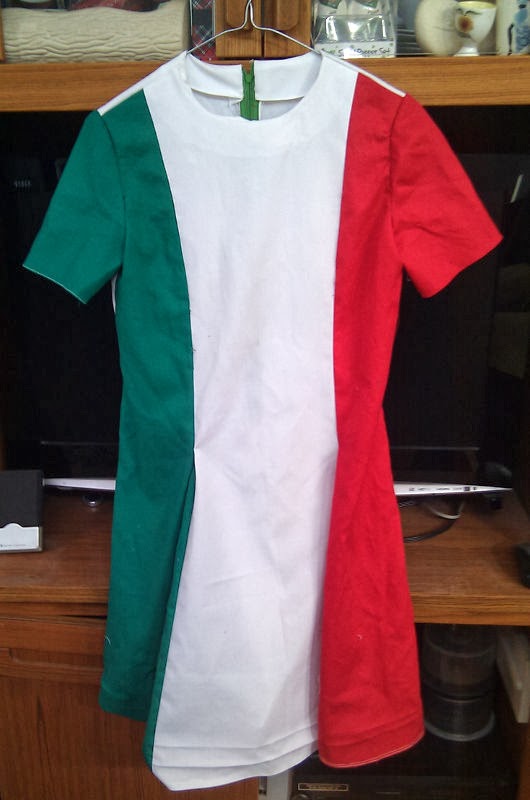 Didn't have to ask for help either. Love it when this happens. Means I'm learning something or the pattern was ridiculously simple. Well, bit of both perhaps.
Here is the final dress, modelled by the girl:

Same as the other one except for hemming and the bow.
The hemming was done on a Singer 319K I picked up free of charge two weeks ago. It was seized but a full weekend later and it's really very smooth and beautiful. Had to re-do the wiring too. Would have done the whole dress on this machine except a few days ago I won a 1960 401a on eBay for $13.45, also not working. Funny how easy it is to get these things working and it was hard to select one for this job, seeing as both were seemingly perfectly suited. The 401a got the most work done but when I tried blind hemming it, I needed instructions. The 320K2 manual is the only one I had at hand, so grabbed it. They were specifically for the 320/319 so I grabbed the 319 and got to work. I have to say, Singer designed some amazing machines in the late 1950s. Both of these machines were made around the same time, and they're both smooth and almost faultless. If I were making or hemming jeans, though, I'd go for a 201 or my 96K. The small motors aren't really up to it.
So, carefully selected some red and some green drill then started the tests. Cut off a little red and dropped it into some water. Yes, the colour started haemorrhaging instantly. The green just as bad. Couple of litres of water and about 1/2 a cup of salt and lowered all of the red into it. A couple of hours later rinsed it and not much came out! Great stuff. Emptied it and repeated with the green.
So, with Simplicity 5945 (view 1), I simply replaced the side panels with a green on one side and a red on the other.
It was easy to make this and only took half a day to get this far:
Here is the final dress, modelled by the girl:
Same as the other one except for hemming and the bow.
The hemming was done on a Singer 319K I picked up free of charge two weeks ago. It was seized but a full weekend later and it's really very smooth and beautiful. Had to re-do the wiring too. Would have done the whole dress on this machine except a few days ago I won a 1960 401a on eBay for $13.45, also not working. Funny how easy it is to get these things working and it was hard to select one for this job, seeing as both were seemingly perfectly suited. The 401a got the most work done but when I tried blind hemming it, I needed instructions. The 320K2 manual is the only one I had at hand, so grabbed it. They were specifically for the 320/319 so I grabbed the 319 and got to work. I have to say, Singer designed some amazing machines in the late 1950s. Both of these machines were made around the same time, and they're both smooth and almost faultless. If I were making or hemming jeans, though, I'd go for a 201 or my 96K. The small motors aren't really up to it.
Sunday, 23 February 2014
Another freebie
On Gumtree the other day there was a 319K in a treadle cabinet. Strange thing, because although the cabinet is the same era the machine had its own original motor and light. So of course I separated them. Popped a 227 head into the cabinet with a new treadle belt and the 319K went into a Pfaff portable box.
The 319 is in absolutely amazing condition. Well it is now: I spent two whole days cleaning oiling and setting things, as the machine was pretty much in need of everything. The needle in there was not the correct 206x13 or even the commonly substituted 15x1, but a round shank industrial. Best not to mess about, so I didn't test it out. The power lead had insulation that was falling off so the plug wasn't going anywhere near the 240V outlet.
The service book is available from the yahoo group's files. Pictures aren't clear but the information is there. I went through everything possible, hence the two day restoration. It also came with a full set of discs.
Here's what it looks like now:
 It took a really long time to get the bight width lever right. The problem was that it was seized up. I moved it a little with the pliers and cloth, but no amount of oil was going to get this thing moving properly. Taking it apart revealed a load of gunk just about everywhere. Took a long time to de-gunk it but it's now like new!
If you do this job on this model, I'd advise you don't do it without the service manual.
The 319 is in absolutely amazing condition. Well it is now: I spent two whole days cleaning oiling and setting things, as the machine was pretty much in need of everything. The needle in there was not the correct 206x13 or even the commonly substituted 15x1, but a round shank industrial. Best not to mess about, so I didn't test it out. The power lead had insulation that was falling off so the plug wasn't going anywhere near the 240V outlet.
 |
| How she came to me |
Here's what it looks like now:
If you do this job on this model, I'd advise you don't do it without the service manual.
Tuesday, 28 January 2014
Giveaways
I saw an ad on Gumtree a few weeks ago and responded immediately. Yes free machines. Six of them and no two the same.
Pinnock 101, Regal De-Luxe Zig-zag, Singer 306k, Pfaff 60, Bernina 530-2 record, Singer 287N
It's not as great a deal as it sounds. I promised to re-home as many as I could fix. Easiest was the Singer 287N. Japanese machine, 1982. Very clean and well maintained. I just checked it thoroughly, oiled it and put it on Gumtree for $30. Naturally it was sold within 12 hours. The buyer couldn't come get it either so I had to home deliver.
The other Singer (306) is missing a few bits that would make it impossible to use as-is. The bobbin case (specific to 306 and 319s) was missing as was the chrome reflector for the light. Neither part is easily replaceable. It was also cosmetically in poor shape. Best part, though, was that it came with a complete set of pattern cams. The Pinnock 101 was a brilliant machine but somehow the hand wheel was badly bent! It absolutely must have been dropped on it. I straightened it out with the vice and some tools and spent many hours cleaning and oiling. Sold it yesterday for half the cost of a service. It was a beautiful baby blue and came with the darning foot. I tested this by doing a little embroidery. It was the perfect machine for this having a vertical bobbin. Lovely machine.
The Pfaff 60 appears to be worthless (they don't sell on eBay) and mine is missing its slide plate, so I guess it'll be staying with me a while.
The Regal de-luxe is a Japanese 1960s machine. It's beautiful and dripping with chrome. Loved it but it had to go. It went quickly too for less than half a service.
The Bernina I'm keeping. I've wanted one for ages but they seemed so expensive. Well, it seems that only applies to 1970s models. One like mine went last week on eBay for barely anything!
Pinnock 101, Regal De-Luxe Zig-zag, Singer 306k, Pfaff 60, Bernina 530-2 record, Singer 287N
It's not as great a deal as it sounds. I promised to re-home as many as I could fix. Easiest was the Singer 287N. Japanese machine, 1982. Very clean and well maintained. I just checked it thoroughly, oiled it and put it on Gumtree for $30. Naturally it was sold within 12 hours. The buyer couldn't come get it either so I had to home deliver.
The other Singer (306) is missing a few bits that would make it impossible to use as-is. The bobbin case (specific to 306 and 319s) was missing as was the chrome reflector for the light. Neither part is easily replaceable. It was also cosmetically in poor shape. Best part, though, was that it came with a complete set of pattern cams. The Pinnock 101 was a brilliant machine but somehow the hand wheel was badly bent! It absolutely must have been dropped on it. I straightened it out with the vice and some tools and spent many hours cleaning and oiling. Sold it yesterday for half the cost of a service. It was a beautiful baby blue and came with the darning foot. I tested this by doing a little embroidery. It was the perfect machine for this having a vertical bobbin. Lovely machine.
The Pfaff 60 appears to be worthless (they don't sell on eBay) and mine is missing its slide plate, so I guess it'll be staying with me a while.
The Regal de-luxe is a Japanese 1960s machine. It's beautiful and dripping with chrome. Loved it but it had to go. It went quickly too for less than half a service.
The Bernina I'm keeping. I've wanted one for ages but they seemed so expensive. Well, it seems that only applies to 1970s models. One like mine went last week on eBay for barely anything!
 |
| Pinnock 101 |
 |
| Regal Super Deluxe |
 |
| Singer 287N Starlet |
A manly machine
I bought a Singer 206K10 around Christmas. It's the industrial version of the 206 which is the earlier version of the 319. Took ages to work out the sub-model but fun. It cost $6.25 and included the irons but no table. Since I'm on school holidays out came the power tools and I built a table top, bolted everything on and tested her out. Wiring very dodgy (started smoking from the light cord) so re-wired it and all was hunky dory. The motor is powerful but is like a conventional motor (starts up when you put your foot on the foot controller). A week or so later a full sized machine with bench was listed on Gumtree for $100. Hmmm... yes I bought it. 96K49 (1952) and very scary machine. The guy hadn't oiled it for ages, it needed a clean and it wasn't threaded properly (either top thread or bobbin), oh and it had the wrong needle. Finally the bobbin was tightened right up. I have no idea how he got it to sew at all when I was there, but even the thread was old and very brittle. Tossed it and gave it a good clean. Now even more scary and amazingly fast. Sewed a new cover for my back seat in cheap (faux suede - it was reeeeaaal cheap) upholstery fabric. A quick stab gets you about 60 stitches! Doesn't seem to matter how many layers either. Anyway, it seems this is the way to do it (upholstery).
I've had to learn about needles and threads, they have to match and you should use the smallest needle you can for the smallest amount of damage to your fabric. A line of stitching had to be unpicked from the faux suede today. Seems it's more like real suede than I'd wanted: The size 18 needle left loads of big holes. Maybe a 16 next time.
That same week, I bought a second machine head for it: A 96K41 (1947). Dec-Jan seems to be a great time to buy an industrial. Saw a Pfaff industrial last night on Gumtree for $90. Amazing. Well, can't imagine I'll be getting rid of this one, particularly now it has a spare head. Perhaps I should call it "Zaphod".
I've had to learn about needles and threads, they have to match and you should use the smallest needle you can for the smallest amount of damage to your fabric. A line of stitching had to be unpicked from the faux suede today. Seems it's more like real suede than I'd wanted: The size 18 needle left loads of big holes. Maybe a 16 next time.
That same week, I bought a second machine head for it: A 96K41 (1947). Dec-Jan seems to be a great time to buy an industrial. Saw a Pfaff industrial last night on Gumtree for $90. Amazing. Well, can't imagine I'll be getting rid of this one, particularly now it has a spare head. Perhaps I should call it "Zaphod".
 | ||
| 206K10 - yes it's a centennial |
 |
| 96K49 from 1952. Fantastic but scary. |
Friday, 6 December 2013
Decline and Fall of the Australian Clothing Industry
I get sad when thinking about the loss of
industries like clothing manufacture, and disagreed strongly with Paul
Keating in his interview recently with Kerry O'Brien (that four part
documentary that finished last week) where he said that it was something
he thought was a good thing, all these people losing their jobs in
manufacturing. He said they just got a better job. Not only is that certain bollocks, but consider the loss of skill with these industries?
Since almost nobody manufactures clothing in Australia and those
who worked in the industry are literally dying off, we now rely on third world
countries and China to make our clothing. We should all know that their
conditions and wages are very significantly worse than those who worked
in our factories. In what way does this make our country or the
world better?
Now that we don't make our clothing here, all the equipment has also gone "offshore" permanently. I feel that we have lost something important. How can we be comfortable with relying on third world countries? How can we be OK with mistreatment of the people who make our clothes just so we can pay almost nothing. I know I felt better with a "Made in Australia" label (or Britain, Ireland, USA) because the workers were not mistreated. I can't support slavery just because the slaves are in a different country. Think about that when you buy your next piece of clothing.
My affection for vintage machines is an extension of my affection for quality, locally made garments. I love my Pinnock machines (although I don't use them currently). Made in Adelaide and beautiful things for sure. There's no need to pollute the air shipping them to Australia (ships can spew out any amount of pollution, as anti pollution laws don't apply to shipping), because they were proudly made here. Go into a shop and look at a new "plastic wonder" sewing machine. Made in China, plastic, electronic. Sure it seems to do everything you want it to, but try sewing through a couple of layers of denim and it won't. Ask about its warranty - 12 months? It will break down shortly after this (it's meant to). Now ask who fixes them and how much they'd charge! Not to mention the extreme discomfort that I for one get when the machine continues after I remove my foot from the controller (the computer feels it necessary to finish a cycle). Older machines don't break down often and if maintained to a basic standard they may never break down at all. Of the fifty or so old machines I've owned, only one has ever broken. The Singer 498 Stylist, and this was because Singer started using plastic gears in the late 1960s. However, it was still easy and cheap to fix, and to give it credit the original plastic gears did last over forty years.
So if you ever wondered why anyone would ever pay $20 for a t-shirt, now you know. If you ever wondered why I rave about a fifty something year old sewing machine, now you know.
Additionally, I do value a treadle: Summer in Australia always comes with power outages. In the middle of a seam? No problem, pop the machine into a treadle cabinet and in a minute or two you're finishing your seam.
Now that we don't make our clothing here, all the equipment has also gone "offshore" permanently. I feel that we have lost something important. How can we be comfortable with relying on third world countries? How can we be OK with mistreatment of the people who make our clothes just so we can pay almost nothing. I know I felt better with a "Made in Australia" label (or Britain, Ireland, USA) because the workers were not mistreated. I can't support slavery just because the slaves are in a different country. Think about that when you buy your next piece of clothing.
My affection for vintage machines is an extension of my affection for quality, locally made garments. I love my Pinnock machines (although I don't use them currently). Made in Adelaide and beautiful things for sure. There's no need to pollute the air shipping them to Australia (ships can spew out any amount of pollution, as anti pollution laws don't apply to shipping), because they were proudly made here. Go into a shop and look at a new "plastic wonder" sewing machine. Made in China, plastic, electronic. Sure it seems to do everything you want it to, but try sewing through a couple of layers of denim and it won't. Ask about its warranty - 12 months? It will break down shortly after this (it's meant to). Now ask who fixes them and how much they'd charge! Not to mention the extreme discomfort that I for one get when the machine continues after I remove my foot from the controller (the computer feels it necessary to finish a cycle). Older machines don't break down often and if maintained to a basic standard they may never break down at all. Of the fifty or so old machines I've owned, only one has ever broken. The Singer 498 Stylist, and this was because Singer started using plastic gears in the late 1960s. However, it was still easy and cheap to fix, and to give it credit the original plastic gears did last over forty years.
So if you ever wondered why anyone would ever pay $20 for a t-shirt, now you know. If you ever wondered why I rave about a fifty something year old sewing machine, now you know.
Additionally, I do value a treadle: Summer in Australia always comes with power outages. In the middle of a seam? No problem, pop the machine into a treadle cabinet and in a minute or two you're finishing your seam.
Pyjamas for my daughter
These were from a Vogue pattern (EDIT: I lied! They were Simplicity. Number 5552 to be exact), which I just spent some time looking for (unsuccessfully). I'll edit it in when I find it.
(edited out the bit where I raved about vogue patterns - oy!). The garment was very pretty too. Here is the finished garment, modelled by my lovely child:
 It was pretty easy to follow in general, and no doubt I'm becoming slowly better versed at interpreting these instructions, but the older the pattern, the more knowledge they assumed. Simply put, until about 50 years ago, most women bought patterns, fabric and notions then headed home to their sewing machine to put it all together. It wasn't a hobby, but a necessary part of life. For me it's a luxury, a hobby, but self sufficiency seems to be something I value more as I get older.
The pants were made on my VS2, the top on the 320k.
I'm now working on a pair (different design - mine are really a Vogue pattern).
(edited out the bit where I raved about vogue patterns - oy!). The garment was very pretty too. Here is the finished garment, modelled by my lovely child:

The pants were made on my VS2, the top on the 320k.
I'm now working on a pair (different design - mine are really a Vogue pattern).
Subscribe to:
Posts (Atom)