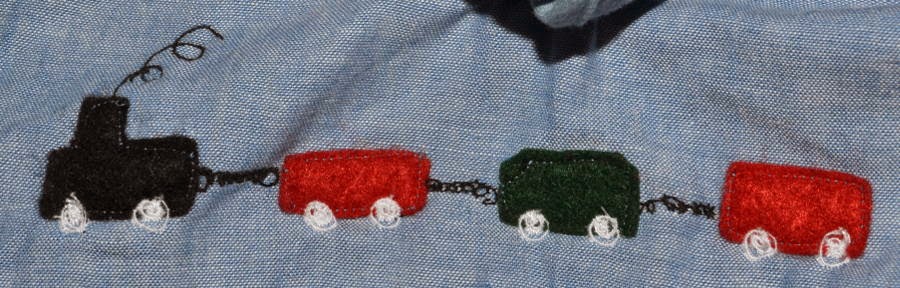
I made a romper suit for my niece's son the other day from a 1950s pattern. The instructions were bloody awful (confusing and ambiguous) but there was supposed to be a train transfer in the packet. Well, it was second hand, so it wasn't there. I traced the pieces (train and carriages) in coloured felt and embroidery was the only way to do the smoke, wheels and linkages. Here's how it turned out:
The 320k came with a darning/embroidery foot and an embroidery hoop.They look like this:
The hoop is supposed to keep the fabric tight but I couldn't get it on half the time due to stitching, folding etc which of course are far more common on little kids' clothing. So, here is how you do it without the hoop: Pull the fabric tight. Then the foot was the only special item needed.
Cover the feed dogs, attach the special foot, hold the fabric tight and move the fabric where you want the stitches to go. The result isn't too bad for a first attempt and I can see many places this can be used (practically anything can be personalised now!)
Saturday, 9 November 2013
Embroidery on the 320k
Labels:
320,
embroidery,
singer
Location:
Victoria, Australia
Friday, 8 November 2013
A "new" machine
On Gumtree a week ago there was an ad for a fiddle base VS2 for $150! How couldn't I buy it?
So, picked it up Saturday morning and by the afternoon it was at home:
Isn't she lovely? Came with the original coffin top too:
I love this machine. I wasn't able to use it until Wednesday but when I did, I tried out a 1940s buttonholer:
Now there's no reason the swiss zigzagger won't work on this machine. 1891, vibrating shuttle, will probably work with any attachment that works on a 66/99/201/221 or 222 so I'm keen to make something on it.
So, picked it up Saturday morning and by the afternoon it was at home:
Isn't she lovely? Came with the original coffin top too:
I love this machine. I wasn't able to use it until Wednesday but when I did, I tried out a 1940s buttonholer:
Now there's no reason the swiss zigzagger won't work on this machine. 1891, vibrating shuttle, will probably work with any attachment that works on a 66/99/201/221 or 222 so I'm keen to make something on it.
Wednesday, 23 October 2013
A few manuals
It's one of those things that bothers me: People sell downloads of sewing machine manuals, yet they don't own the copyright. You might think it's still good value and convenient for you to have a printable copy but it annoys the hell out of me. If you didn't write it, you shouldn't be making money from it.
Here are two sewing machine manuals I Googled and found really difficult to locate. These are both scanned manuals that I scanned myself.
Please don't attempt to sell it. Click the link, the pictures are just pictures.
Necchi Supernova 2 *updated because ubuntu one is shutting down
Pinnock Sewmaster
Here are two sewing machine manuals I Googled and found really difficult to locate. These are both scanned manuals that I scanned myself.
Please don't attempt to sell it. Click the link, the pictures are just pictures.
Necchi Supernova 2 *updated because ubuntu one is shutting down
Pinnock Sewmaster
Sunday, 20 October 2013
Goodbye to the old, hello to the new
No, I'm not going plastic on you, good people, but the lounge room had started looking like a warehouse, with boxes stacked on cabinets and it made actual sewing (yes I still do that) really difficult. So, what should I do? Buy another machine in a cabinet of course! Two or three weeks ago (on Sunday night) someone had put an ad for a six drawer Singer cabinet in need of restoration on Gumtree for $50. Well, it looked OK in the ad, and as long as there's nothing missing I'm up for it. Yes it's shabby and yes I have no room. It lived in the back of the car for a few days. It took only a few days to get rid of the two cabinets that lived in my lounge room. My beloved 319k in lovingly restored 1960 cabinet and a model 66, which I had swapped the presser bar with a later 66 to fit side clamping feet. This brings me to what a PITA the back clamping 66 is.
The story of the back clamping goes back a bit over 100 years. I read that Singer thought it a pretty nifty idea to have the 66 as a back clamper just after they had bought the Wheeler and Wilson factory in the U.S. seeing as that's what they used.
It was a disaster, of course, and meant that the 66 had to use feet that were different to all other models, and their customers indicated their unhappiness with the back clamp. Around 1922 Singer caved in to the pressure and made all future 66s side clampers, making them compatible with, well, everything.
So every time I get a 66 it seems to be a back clamper. When the six drawer car crisis happened, I hastily converted the back clamper to use the only side clamp version I had, advertised it for a low price and of course it sold quickly. So, got the six drawer cabinet in, looked at the machine inside and it was, you guessed it, a Singer 66 back clamper! It did come with a couple of back clamp feet (which is unusual) but I'm still pretty unhappy about it.
Here's a summary of movements for the past month or so:
Out
Singer 221k featherweight (centennial, manufactured 1950)
Singer 66k in treadle cabinet (1922 - only just a back clamper!)
Singer 319k in 1960 model cabinet.
All of these seem to have gone to the right people. They were all going to see further use as sewing machines. Decisions on what had to go weren't difficult. The 319k is in a cabinet, and I have a 320k that's also in the lounge room. I did keep the cams from the 319, though. Can't understand why the 320k didn't have them, or the darning plate.
OK, now this stuff I have to rely on my memory for, because there are usually so many. In
Singer 201k treadle, original deco treadle cabinet (1946)
Singer 66k treadle, original six drawer treadle cabinet (1912)
Singer swiss zigzag attachment
Singer attachment lot (incl two more of the above, plus two buttonholers). Not arrived yet.
Singer green button hole attachment (for low shank machines, uses cams for different types of button holes) - this has not arrived yet, more than a week after I paid for it. Not happy.
Don't have a pic of the swiss zigzagger (Google it - plenty of pictures around). It has a built-in walking foot and originally came with pattern cams (I got one out of the ten), which makes it highly desirable for a straight sewing machine like a featherweight, a 201 or a 66.
The story of the back clamping goes back a bit over 100 years. I read that Singer thought it a pretty nifty idea to have the 66 as a back clamper just after they had bought the Wheeler and Wilson factory in the U.S. seeing as that's what they used.
It was a disaster, of course, and meant that the 66 had to use feet that were different to all other models, and their customers indicated their unhappiness with the back clamp. Around 1922 Singer caved in to the pressure and made all future 66s side clampers, making them compatible with, well, everything.
So every time I get a 66 it seems to be a back clamper. When the six drawer car crisis happened, I hastily converted the back clamper to use the only side clamp version I had, advertised it for a low price and of course it sold quickly. So, got the six drawer cabinet in, looked at the machine inside and it was, you guessed it, a Singer 66 back clamper! It did come with a couple of back clamp feet (which is unusual) but I'm still pretty unhappy about it.
Here's a summary of movements for the past month or so:
Out
Singer 221k featherweight (centennial, manufactured 1950)
Singer 66k in treadle cabinet (1922 - only just a back clamper!)
Singer 319k in 1960 model cabinet.
All of these seem to have gone to the right people. They were all going to see further use as sewing machines. Decisions on what had to go weren't difficult. The 319k is in a cabinet, and I have a 320k that's also in the lounge room. I did keep the cams from the 319, though. Can't understand why the 320k didn't have them, or the darning plate.
OK, now this stuff I have to rely on my memory for, because there are usually so many. In
Singer 201k treadle, original deco treadle cabinet (1946)
Singer 66k treadle, original six drawer treadle cabinet (1912)
Singer swiss zigzag attachment
Singer attachment lot (incl two more of the above, plus two buttonholers). Not arrived yet.
Singer green button hole attachment (for low shank machines, uses cams for different types of button holes) - this has not arrived yet, more than a week after I paid for it. Not happy.
![]() | ||
| Out: 66k treadle |
![]() |
| Out: 221k Featherweight |
![]() |
| Out: the 319k |
![]() |
| In: The 66 - Did I mention it's a redeye? |
![]() |
| In: The redeye's home. The top needs new veneer |
Labels:
201,
201K,
201P,
221k,
319,
319K,
320,
320k,
320k2,
attachment,
button holer,
buttonholer,
cabinet,
machine,
model 66,
sewing cabinet,
sewing machine,
swiss,
zig-zag
Wednesday, 18 September 2013
Finished a dress, made with 201s and got two more machines
Can't say 201k, because the machine I started it with was a 201p (the tan one). Used the 319k for zigzag finishing seams and putting in the hook.
Here's the dress:
It should fit her, but she lives on the other side of the planet so it might be a while before I get feedback.
Here's the machine I used to finish it. The knee lever was really hard to get used to. I kept accidentally knocking the lever and sewing the thread into a knot.
The most important thing I discovered with this project was how to pre-finish a seam: Cut the fabric out using pinking shears! If you cut it the right size, the seam edges are pre-finished and no ZZ will be necessary.
Being unable to control my sewing machine addiction meant that since last week I bought two more machines. The first was another 319k but with a free arm. It's called a 320k but identical except for the removable bed. This feature made it horrendously expensive to produce apparently, so they didn't make that many of them.
The second was a Singer 401g (I think). It was on eBay for a while and nobody bid on it. It was re-listed at the same price so I bought it. I haven't picked it up yet but am quite excited. Here are the new ones:
There are a few problems with these two machines, being that the first one can't go into a cabinet because of the removable bed, so I'll have to sell my beautiful 319k in its cabinet. Good news is that the 401g can be treadled, so I can swap the 319k with a treadle cabinet (and free up some shed space).
Here's the dress:
It should fit her, but she lives on the other side of the planet so it might be a while before I get feedback.
Here's the machine I used to finish it. The knee lever was really hard to get used to. I kept accidentally knocking the lever and sewing the thread into a knot.
The most important thing I discovered with this project was how to pre-finish a seam: Cut the fabric out using pinking shears! If you cut it the right size, the seam edges are pre-finished and no ZZ will be necessary.
Being unable to control my sewing machine addiction meant that since last week I bought two more machines. The first was another 319k but with a free arm. It's called a 320k but identical except for the removable bed. This feature made it horrendously expensive to produce apparently, so they didn't make that many of them.
The second was a Singer 401g (I think). It was on eBay for a while and nobody bid on it. It was re-listed at the same price so I bought it. I haven't picked it up yet but am quite excited. Here are the new ones:
![]() |
| Quite rare Singer 320k2 |
![]() |
| Singer 401g made in Germany |
Labels:
201,
201K,
201P,
320,
320k,
320k2,
401g,
sewing,
sewing cabinet,
sewing machine,
singer,
treadle,
vintage,
vintage sewing machines
Tuesday, 10 September 2013
new machines
OK, I've been accumulating some new ones. Got a 221k then a 222k, a Necchi Supernova, two 201ks and a model 66 in the past month or so. I've sold a few to make some room, but mostly just re-organised the shed so more will fit (I think I'm getting away with it. No, really). The supernova is said to be a potential time sink, so it's going to have to wait until the school holidays when I'll have a little more time to get caught up.
I think I've fallen for the 201s. Absolutely brilliant, smooth machines they are. Alex Askaroff said the earlier ones have the edge purely because of their massive weight (they can sew faster or some such insanity). The stitch is amazing and fuss-free. I'm going to try out sewing through several layers of denim, just to be convinced it can do it.
Here's a small assortment of new ones:
I think I've fallen for the 201s. Absolutely brilliant, smooth machines they are. Alex Askaroff said the earlier ones have the edge purely because of their massive weight (they can sew faster or some such insanity). The stitch is amazing and fuss-free. I'm going to try out sewing through several layers of denim, just to be convinced it can do it.
Here's a small assortment of new ones:
fixing a bakelite foot or knee controller
I bought another 201k on the weekend. It's aluminium and a knee controlled beast. Just couldn't resist it for $29. Pretty sure the guy who sold it to me was lying when he said he didn't know how to use it, but the motor ran at full speed as soon as the switch was flicked. This is caused by the capacitors shorting out. The capacitors were used to prevent any interference from the motor affecting things like TV sets and radios. These days they're not really necessary since most devices have supression built in. Both foot and knee controllers have the same bits inside so instructions are the same.
So, just remove the four screws holding the base on, take the capacitors out like I did and your machine should be back to working. If yours is a knee controller, remove it from the case first. It's obvious how to do this.
Subscribe to:
Posts (Atom)