I bought a 401g (German made) a few months ago. Apparently it's a fantastic machine that can do everything. It's called "slant-o-matic" and I say apparently, because I don't use it. Well, I love sewing on the 320k so why change? The 401 was just there because I was told I had to have one, and it appeared.
So, now that it was sitting on the shed for months, I see a 401a (American version). This model is probably not as good and it said "doesn't work" on the ad. Well, how couldn't I have a go? I picked it up and had it fixed in no time. Can't even recall what the problem was, but was probably lint. SO which one to keep... You'd think the German version. It is truly more handsome and almost certainly better engineered and built. That's not just because of the German thing, but they were made later, in the 1960s. The American one stays, because it had a full set of accessories and the original manual. It was a one owner machine and apparently I value that sort of thing more!
Here is the 401g:
Isn't it lovely? When you look from the side you can see why it's called slant-o-matic:
And the 401a:
Very similar but it doesn't have that rocketeer thing happening at the top. Well, the differences when a machine is this good are stupid. It's like choosing whether to live in a mansion in Paris or a mansion in Switzerland: They're both such unbelievably good options that it doesn't matter!
The 401 has a vertical bobbin, so you can also do embroidery with it. As a bonus, this machine was designed so you can fit not just a needle into its needlebar, but two needles! Yes, two needles can go in, meaning you don't have to buy twin needles for special patterns.
Friday, 6 December 2013
Singer 201s are very common, not so popular
It's a bit sad really. The greatest domestic stitcher ever made is the Singer 201. It has specially hardened gears and does a perfect stitch. It sews through practically anything with no fuss whatsoever. In its day, it was, fittingly, the most expensive you could buy and Singer still sold millions and millions of them!
From the moment I used one, my eyes widened and I was deeply impressed with the ease with which it did its job.
Lately there seems to be a flood of them on eBay and Gumtree, and of the last two I got, the first (last Saturday) was free in a cabinet. It was, admittedly, seized and took about two hours solid work to clean and lubricate it, than another ten hours to get it moving properly! The foot controller was also faulty and didn't work at all. It took only an hour to fix and adjust this because I didn't disassemble the carbon pile (the wiring was the problem). I now make a point of always removing any capacitors in foot or knee controllers, and always checking and cleaning the motors. Cleaning them improves contact between the brushes and the armature, and results in a stronger motor.
The second machine was $50, and I didn't actually want this one, but in the picture with the machine was a very nice looking Swiss Zigzagger! It seems I was the first person to call: First of dozens according to the lady. She said she'd done research and they seem to sell for about $50. I told her about the Swiss ZZ and that it was probably the reason for its popularity. Got the machine, attachment and a buttonholer into the car and went home. She had admitted that she had never cleaned, oiled or serviced it and when it got stuck she just pulled out whatever was obviously in the way and kept going again! Needless to say it had an unusual amount of lint and dirt. Additionally, the motor's wiring, like most knee machines, was really stuffed. I carefully replaced the dangerous bits and repaired any damaged insulation. The Swizz ZZ was is very good condition, and all pattern cams were present in their original package. The buttonholer was seized up (I'd never seen one so stuck), and it took days of jiggling to loosen it up. Still not happy with it, so more work required there.
Before I post pictures, I have to suggest why 201s aren't more popular. It is a domestic machine that only does straight stitch. That's it, simply, these days people either want a domestic to do everything or an industrial straight stitcher. The 201 is not to be ignored, however. Add a good zigzagger and buttonholer (which the lady had) and you have a machine that can not only do a perfect stitch but everything else you'd expect. It won't, however, do free motion embroidery/darning very well. Apparently the horizontal bobbin makes it difficult for the machine to maintain good tension doing this.
OK, so it can do almost everything. What are you waiting for? Go get one! They're cheap, easy to fix and use the most common Singer bits: Class 66 bobbins, 15x1 needles, all common attachments, common bulbs and drive belts etc.
Now the $50 one:
Incidentally, I generally sell these machines for what I paid plus whatever it costs in fuel and car wear and tear. This makes for a very quick sale, very happy people and a lovely machine that will immediately see more service.
From the moment I used one, my eyes widened and I was deeply impressed with the ease with which it did its job.
Lately there seems to be a flood of them on eBay and Gumtree, and of the last two I got, the first (last Saturday) was free in a cabinet. It was, admittedly, seized and took about two hours solid work to clean and lubricate it, than another ten hours to get it moving properly! The foot controller was also faulty and didn't work at all. It took only an hour to fix and adjust this because I didn't disassemble the carbon pile (the wiring was the problem). I now make a point of always removing any capacitors in foot or knee controllers, and always checking and cleaning the motors. Cleaning them improves contact between the brushes and the armature, and results in a stronger motor.
The second machine was $50, and I didn't actually want this one, but in the picture with the machine was a very nice looking Swiss Zigzagger! It seems I was the first person to call: First of dozens according to the lady. She said she'd done research and they seem to sell for about $50. I told her about the Swiss ZZ and that it was probably the reason for its popularity. Got the machine, attachment and a buttonholer into the car and went home. She had admitted that she had never cleaned, oiled or serviced it and when it got stuck she just pulled out whatever was obviously in the way and kept going again! Needless to say it had an unusual amount of lint and dirt. Additionally, the motor's wiring, like most knee machines, was really stuffed. I carefully replaced the dangerous bits and repaired any damaged insulation. The Swizz ZZ was is very good condition, and all pattern cams were present in their original package. The buttonholer was seized up (I'd never seen one so stuck), and it took days of jiggling to loosen it up. Still not happy with it, so more work required there.
Before I post pictures, I have to suggest why 201s aren't more popular. It is a domestic machine that only does straight stitch. That's it, simply, these days people either want a domestic to do everything or an industrial straight stitcher. The 201 is not to be ignored, however. Add a good zigzagger and buttonholer (which the lady had) and you have a machine that can not only do a perfect stitch but everything else you'd expect. It won't, however, do free motion embroidery/darning very well. Apparently the horizontal bobbin makes it difficult for the machine to maintain good tension doing this.
OK, so it can do almost everything. What are you waiting for? Go get one! They're cheap, easy to fix and use the most common Singer bits: Class 66 bobbins, 15x1 needles, all common attachments, common bulbs and drive belts etc.
| |
| The free one, aluminium machine from 1954 |
|
| ||||
|
|
Saturday, 9 November 2013
Tip Shop Overlocker
People have been asking me for ages now why I don't have an overlocker (Americans call it a 'serger'). The reason is not knowing how they worked and it would obviously raise the level of complexity of my life a bit. Not to mention that they're expensive: New ones were a lot more expensive than sewing machines, so I looked at second hand (eBay). Very expensive there too (more than $100).
The tip shop had one last week for $30. Here it is,
It looks a bit plastic for me so I asked a friend and my partner (by SMS) if it was any good. My friend is my enabler, so she said yes. I picked it up and ooh... it passes the weight test. About 15kg. The tip shop guy plugged it in for me and tested it. Well, the motor went, so I was in.
The machine was made from 1981 in Japan (I just changed that from "France" - where did I get that from??). Funny, my new favourite machine is from 1891. Anyway, the manual was very clear (got it from singerco.com) so after a good clean I read how to thread it and set the tensions. Also disconnected the knife (the default behaviour is to cut the fabric as it gets fed through) because I'd like to do the cutting. EDIT: Re-enabled the knife - Oh, so handy!
Test fabric was denim and the results were a lovely chain around the edge. Might not use it for every garment but it's a good thing to have if it's needed.
Embroidery on the 320k
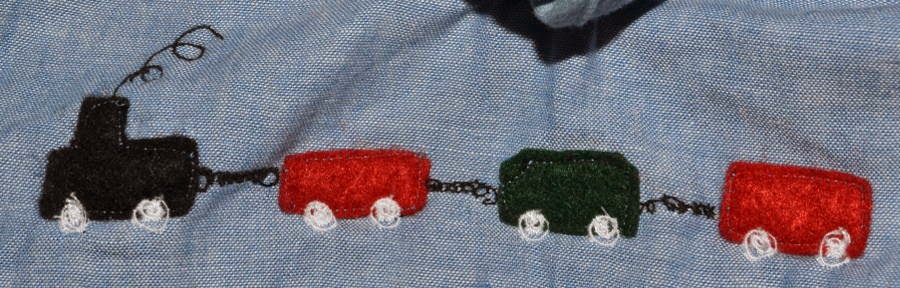
I made a romper suit for my niece's son the other day from a 1950s pattern. The instructions were bloody awful (confusing and ambiguous) but there was supposed to be a train transfer in the packet. Well, it was second hand, so it wasn't there. I traced the pieces (train and carriages) in coloured felt and embroidery was the only way to do the smoke, wheels and linkages. Here's how it turned out:
The 320k came with a darning/embroidery foot and an embroidery hoop.They look like this:
The hoop is supposed to keep the fabric tight but I couldn't get it on half the time due to stitching, folding etc which of course are far more common on little kids' clothing. So, here is how you do it without the hoop: Pull the fabric tight. Then the foot was the only special item needed.
Cover the feed dogs, attach the special foot, hold the fabric tight and move the fabric where you want the stitches to go. The result isn't too bad for a first attempt and I can see many places this can be used (practically anything can be personalised now!)
Labels:
320,
embroidery,
singer
Location:
Victoria, Australia
Friday, 8 November 2013
A "new" machine
On Gumtree a week ago there was an ad for a fiddle base VS2 for $150! How couldn't I buy it?
So, picked it up Saturday morning and by the afternoon it was at home:
Isn't she lovely? Came with the original coffin top too:
I love this machine. I wasn't able to use it until Wednesday but when I did, I tried out a 1940s buttonholer:
Now there's no reason the swiss zigzagger won't work on this machine. 1891, vibrating shuttle, will probably work with any attachment that works on a 66/99/201/221 or 222 so I'm keen to make something on it.
Wednesday, 23 October 2013
A few manuals
It's one of those things that bothers me: People sell downloads of sewing machine manuals, yet they don't own the copyright. You might think it's still good value and convenient for you to have a printable copy but it annoys the hell out of me. If you didn't write it, you shouldn't be making money from it.
Here are two sewing machine manuals I Googled and found really difficult to locate. These are both scanned manuals that I scanned myself.
Please don't attempt to sell it. Click the link, the pictures are just pictures.
Necchi Supernova 2 *updated because ubuntu one is shutting down
Pinnock Sewmaster
Sunday, 20 October 2013
Goodbye to the old, hello to the new
No, I'm not going plastic on you, good people, but the lounge room had started looking like a warehouse, with boxes stacked on cabinets and it made actual sewing (yes I still do that) really difficult. So, what should I do? Buy another machine in a cabinet of course! Two or three weeks ago (on Sunday night) someone had put an ad for a six drawer Singer cabinet in need of restoration on Gumtree for $50. Well, it looked OK in the ad, and as long as there's nothing missing I'm up for it. Yes it's shabby and yes I have no room. It lived in the back of the car for a few days. It took only a few days to get rid of the two cabinets that lived in my lounge room. My beloved 319k in lovingly restored 1960 cabinet and a model 66, which I had swapped the presser bar with a later 66 to fit side clamping feet. This brings me to what a PITA the back clamping 66 is.
The story of the back clamping goes back a bit over 100 years. I read that Singer thought it a pretty nifty idea to have the 66 as a back clamper just after they had bought the Wheeler and Wilson factory in the U.S. seeing as that's what they used.
It was a disaster, of course, and meant that the 66 had to use feet that were different to all other models, and their customers indicated their unhappiness with the back clamp. Around 1922 Singer caved in to the pressure and made all future 66s side clampers, making them compatible with, well, everything.
So every time I get a 66 it seems to be a back clamper. When the six drawer car crisis happened, I hastily converted the back clamper to use the only side clamp version I had, advertised it for a low price and of course it sold quickly. So, got the six drawer cabinet in, looked at the machine inside and it was, you guessed it, a Singer 66 back clamper! It did come with a couple of back clamp feet (which is unusual) but I'm still pretty unhappy about it.
Here's a summary of movements for the past month or so:
Out
Singer 221k featherweight (centennial, manufactured 1950)
Singer 66k in treadle cabinet (1922 - only just a back clamper!)
Singer 319k in 1960 model cabinet.
All of these seem to have gone to the right people. They were all going to see further use as sewing machines. Decisions on what had to go weren't difficult. The 319k is in a cabinet, and I have a 320k that's also in the lounge room. I did keep the cams from the 319, though. Can't understand why the 320k didn't have them, or the darning plate.
OK, now this stuff I have to rely on my memory for, because there are usually so many. In
Singer 201k treadle, original deco treadle cabinet (1946)
Singer 66k treadle, original six drawer treadle cabinet (1912)
Singer swiss zigzag attachment
Singer attachment lot (incl two more of the above, plus two buttonholers). Not arrived yet.
Singer green button hole attachment (for low shank machines, uses cams for different types of button holes) - this has not arrived yet, more than a week after I paid for it. Not happy.
Don't have a pic of the swiss zigzagger (Google it - plenty of pictures around). It has a built-in walking foot and originally came with pattern cams (I got one out of the ten), which makes it highly desirable for a straight sewing machine like a featherweight, a 201 or a 66.
The story of the back clamping goes back a bit over 100 years. I read that Singer thought it a pretty nifty idea to have the 66 as a back clamper just after they had bought the Wheeler and Wilson factory in the U.S. seeing as that's what they used.
It was a disaster, of course, and meant that the 66 had to use feet that were different to all other models, and their customers indicated their unhappiness with the back clamp. Around 1922 Singer caved in to the pressure and made all future 66s side clampers, making them compatible with, well, everything.
So every time I get a 66 it seems to be a back clamper. When the six drawer car crisis happened, I hastily converted the back clamper to use the only side clamp version I had, advertised it for a low price and of course it sold quickly. So, got the six drawer cabinet in, looked at the machine inside and it was, you guessed it, a Singer 66 back clamper! It did come with a couple of back clamp feet (which is unusual) but I'm still pretty unhappy about it.
Here's a summary of movements for the past month or so:
Out
Singer 221k featherweight (centennial, manufactured 1950)
Singer 66k in treadle cabinet (1922 - only just a back clamper!)
Singer 319k in 1960 model cabinet.
All of these seem to have gone to the right people. They were all going to see further use as sewing machines. Decisions on what had to go weren't difficult. The 319k is in a cabinet, and I have a 320k that's also in the lounge room. I did keep the cams from the 319, though. Can't understand why the 320k didn't have them, or the darning plate.
OK, now this stuff I have to rely on my memory for, because there are usually so many. In
Singer 201k treadle, original deco treadle cabinet (1946)
Singer 66k treadle, original six drawer treadle cabinet (1912)
Singer swiss zigzag attachment
Singer attachment lot (incl two more of the above, plus two buttonholers). Not arrived yet.
Singer green button hole attachment (for low shank machines, uses cams for different types of button holes) - this has not arrived yet, more than a week after I paid for it. Not happy.
![]() | ||
| Out: 66k treadle |
![]() |
| Out: 221k Featherweight |
![]() |
| Out: the 319k |
![]() |
| In: The 66 - Did I mention it's a redeye? |
![]() |
| In: The redeye's home. The top needs new veneer |
Labels:
201,
201K,
201P,
221k,
319,
319K,
320,
320k,
320k2,
attachment,
button holer,
buttonholer,
cabinet,
machine,
model 66,
sewing cabinet,
sewing machine,
swiss,
zig-zag
Subscribe to:
Posts (Atom)